
Large yellow underwing
Noctua pronuba
Migration boosts numbers so much that traps can hold hundreds in one night (UKMoths)
- J
- F
- M
- A
- M
- J
- J
- A
- S
- O
- N
- D
 Granddad’s Camera
Granddad’s moth trap
Buy the moth trap from Pat’s stall in Millbrook (£95 in the game), switch it on in Granddad’s garden at dusk, and open the egg boxes after sunrise. Every moth here flies in its real months, and a night’s catch depends on the weather and the moon, as it does in a real garden. Facts checked against UK Moths.
How it works in the game
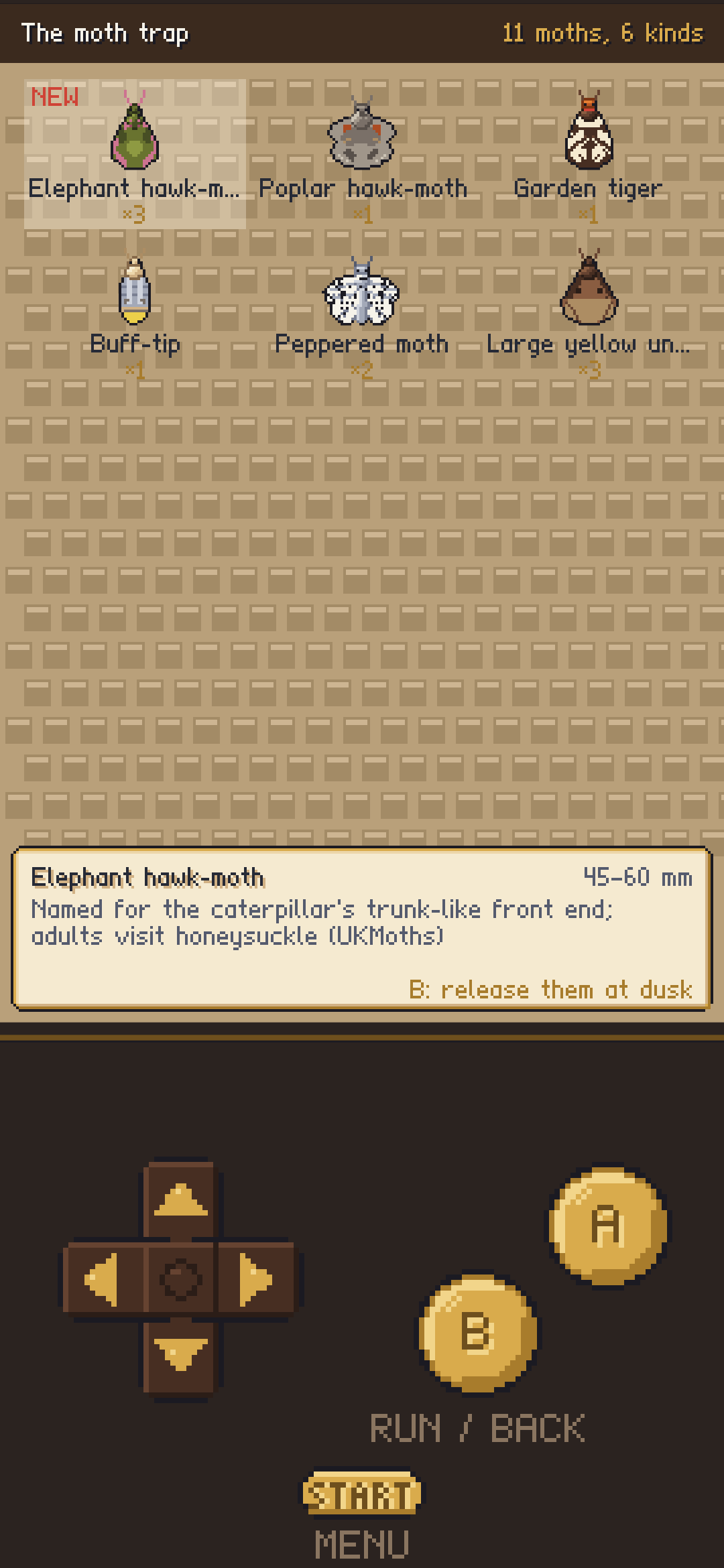
Switch the trap on any evening after dusk, and you’re told what the night looks like: “Hardly any moon. Cloud cover will keep it mild.” That’s a good night. Clear skies get cold, and wind, rain or a bright moon cut the catch.
In the morning the new ones go on your moth list, with a note on each. Then you let them go at dusk, in the long grass where the birds won’t find them.
In a real garden
Warm, still, cloudy nights with little moon are best, and July is the peak. Don’t touch their wings, keep them cool, and release them at dusk in thick cover. How to start mothing, from Butterfly Conservation.
Noctua pronuba
Migration boosts numbers so much that traps can hold hundreds in one night (UKMoths)

Agrotis exclamationis
Always has a black band across the front of the thorax when viewed head-on (UKMoths)

Phlogophora meticulosa
Its folded wings make it look like a withered autumn leaf; recorded in every month (UKMoths)

Deilephila elpenor
Named for the caterpillar's trunk-like front end; adults visit honeysuckle (UKMoths)

Laothoe populi
When disturbed it shows hidden rusty-red hindwing patches as a flash display (UKMoths)

Phalera bucephala
Adults at rest look remarkably like a broken twig of silver birch (UKMoths)


Biston betularia
The classic case of industrial melanism: dark forms dominated parts of northern England, then declined (UKMoths)
Peppered moth (carbonaria). The all-dark carbonaria form spread through sooty industrial Britain, where pale moths on blackened bark were eaten by birds. As the air cleaned up after the Clean Air Acts, it became rare again: a famous case of evolution you can watch.

Phragmatobia fuliginosa
Two broods in the south; brightest in the south, duller in Scotland (UKMoths)

Diachrysia chrysitis
Large areas of metallic colour on the forewings give it its name (UKMoths)

Opisthograptis luteolata
Up to three overlapping generations in the south, only one in the far north, so it flies for months (UKMoths)

Ourapteryx sambucaria
One of our largest geometrid moths, but strictly nocturnal and on the wing mostly in July (UKMoths)

Alsophila aescularia
The female has no wings and is seen crawling on tree trunks at night (UKMoths)

Colostygia pectinataria
The green fades to yellowish-brown or whitish soon after emergence, so fresh moths look brilliant (UKMoths)

Mimas tiliae
Common in the south; still spreading north into North Yorkshire (UKMoths)

Sphinx ligustri
Britain's largest resident hawk-moth; the caterpillar (green with lilac and white side stripes and a curved black horn) is arguably more spectacular (UKMoths)

Smerinthus ocellata
Flashes intense blue-and-black "eyes" on pink hindwings when disturbed (UKMoths)

Arctia caja
Once quite common, it has declined in many places; caterpillars are the familiar "woolly bears" (UKMoths)

Griposia aprilina
The name means "wonder of the day"; museum specimens fade to brownish yellow, so photographs of live ones matter (UKMoths)

Poecilocampa populi
Flies from October to late December; wings look slightly see-through because the scales are thin (UKMoths)

Miltochrista miniata
Its caterpillars eat lichen; common in the south, so scarcer in the Midlands (UKMoths)

Euplagia quadripunctaria
Active by day at flowers and at night at light; was limited to the south coast but is spreading north (UKMoths)

Agrius convolvuli
A migrant that comes to garden Nicotiana; caterpillars are occasionally found but it does not breed here (UKMoths)

Acherontia atropos
The largest moth to appear in Britain; it squeaks when handled and raids beehives for honey (UKMoths)

Catocala fraxini
The "Blue Underwing" was a Victorian collector's favourite, bred in Kent and Norfolk until it died out as a breeding species, and is now recolonising southern counties (UKMoths)
Not when they’re used with care. The moths settle in egg boxes overnight and are let go unharmed. Butterfly Conservation’s advice: don’t touch their wings, keep active moths cool, and release them at dusk in thick vegetation, away from birds.
Warm, still, cloudy nights with little or no moon. Cold, wet or windy nights bring fewer, and fewer moths fly under a full moon. July is the peak of the year.
Early spring, around March. Few species are flying then, so they’re easier to learn one at a time.
24 British moths, from the large yellow underwing, which can fill a trap in late summer, to the Clifden nonpareil, a once-in-a-lifetime catch. Each flies in its real months, and the peppered moth has its dark carbonaria form.