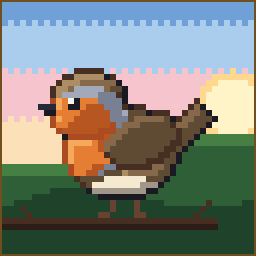

No.072 · Birds · Rare
Scottish crossbill
Loxia scotica
Often called Britain's only endemic bird: a chunky, thick-billed crossbill of the Caledonian pinewoods that looks almost identical to its cousins.
When to look
All year, mostly at dawn and day.
- J
- F
- M
- A
- M
- J
- J
- A
- S
- O
- N
- D
Time of day
- Dawn
- Day
- Dusk
- Night
- Best time
- Day, all year; often near water where it drinks at pools in the morning and early afternoon.
- Where in the game
- the Cairngorms (pine forest)
- Size
- 16–17 cm
- Wingspan
- 27–30 cm
- Lifespan
- Unknown; the oldest ringed bird was 3 years 9 months (BTO)
- Population
- About 6,800 pairs in the UK (2008 survey; BTO)
- Status
- Amber (UK Birds of Conservation Concern, BTO)
Diet
Seeds of Scots pine, taken from the cone with its crossed bill.
Habitat
Scots pine woodland, mostly in the Highlands.
Breeding
Nests very early: females can be on eggs by late February. 3–4 eggs, incubated by the female for 12–14 days; chicks fledge after 20–22 days
Field signs
- A hard 'jip-jip' or 'chup-chup' flight call
- A rain of cone scales and fluttering birds high in the pine crowns
- Cones with scales prised open at an angle
- Bright red males and green females
Did you know?
- Whether it is a full species is 'controversial': some authorities treat it as a large Common Crossbill (BTO).
- The three crossbills (common, parrot, Scottish) are almost identical, and even experts often separate them by call or bill measurements rather than by sight (BTO).
- Crossbills are among our earliest breeders, and a female sitting on eggs in late February is not unusual (BTO).
Moments worth waiting for
- Drinking at a woodland pool
A small flock drops to a rain-pool on the forest track, males and females drinking with a quick dip of the crossed bill.
Photo tip
Try dawn beside a puddle or loch edge where crossbills come to drink, and use a long lens (400–600 mm). Be patient; a clean identification usually depends on call and context.
Be a good naturalist
Never use playback to lure crossbills, especially when they nest in winter or early spring. Keep dogs and crowds away from feeding flocks and nesting pines.
The law
Schedule 1 of the Wildlife and Countryside Act 1981: protected against disturbance at the nest.