
No.001 · Birds · Common
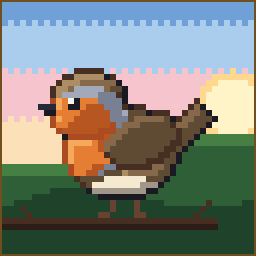
Robin
Erithacus rubecula
Britain's boldest little bird: orange-red face and breast, big dark eyes, and a habit of hopping up beside anyone who turns the soil. It sings almost all year round, even in winter.
When to look
All year, mostly at dawn, day and dusk.
- J
- F
- M
- A
- M
- J
- J
- A
- S
- O
- N
- D
Time of day
- Dawn
- Day
- Dusk
- Night
- Best time
- Dawn to mid-morning all year; sings from dusk lamp-posts in winter. Nests March–July.
- Where in the game
- Millbrook (garden, park, churchyard and urban) and the New Forest (ancient woodland and lawn)
- Size
- Length about 14 cm
- Wingspan
- About 21 cm
- Weight
- About 19 g (BTO adult average)
- Lifespan
- Average about 2 years; the oldest ringed robin lived over 8 years (Wildlife Trusts, BTO)
- Population
- About 7.4 million territories in the UK (BTO, 2016)
- Status
- Green (Birds of Conservation Concern 5, 2021)
Diet
Insects, spiders and worms; berries and seeds in autumn and winter; happily takes mealworms and suet.
Habitat
Gardens, hedgerows, parks and woods; the classic garden bird.
Breeding
Nests March–July in hollows, ivy, old kettles and open-fronted boxes; usually 4–5 eggs, typically 2 broods, occasionally 3.
Field signs
- Bright orange-red face and breast with a grey-blue edge; young birds are speckled brown with no red
- Thin, wistful, warbling song, given by both sexes; sharp 'tic-tic' alarm call
- Solitary bird on a low perch, bobbing and flicking its tail
Did you know?
- Robins hold separate territories even in winter, and both males and females sing to defend them, which is why you hear song in December.
- Robins sometimes sing at night beneath street lights, which is why some people mistake them for nightingales.
- In 2015 the robin was voted Britain's national bird in a public poll run by David Lindo, though it has no official status.
Moments worth waiting for
- Winter song
A robin sings from a bare twig, its breath steaming, defending its winter patch. - Following the spade
A robin drops to the fresh soil a metre from your feet, watching for worms.
Photo tip
Get low and wait beside a spade or fork; robins will land within a metre. Shoot at eye level against a plain background on a bright frosty morning and focus on the eye.
Be a good naturalist
Feed robins only proper foods (mealworms, suet, seed) and never move a nest. Leave fledglings on the ground alone: their parents are close by.
The law
All wild birds, their nests and eggs are protected under the Wildlife and Countryside Act 1981; it is an offence to kill, injure or take them or damage an active nest.